
You’ve booked your ski holiday, and you’re ready to hit the slopes, but you’re not quite sure what level of piste you should be skiing on. Ski run rating can vary across Europe (and across the pond!), making it a little tricky to grasp what you should be looking out for on your piste map.
Check out our handy guide, and understand how to assess what level of ski slope you should be tackling.
Updated: 6th February 2026
What are the Different Levels of Ski Run Rating in Europe?
Typically, ski resorts in Europe follow the same slope ratings. Advanced skiers will have these memorised, but what do these levels actually mean, particularly for newbies? Each colour on a piste map dictates the difficulty of the terrain, and allows skiers to make an informed decision based on their own skill level.
Green Ski Runs
Green runs are for beginners and are the lowest difficulty runs on the mountain. Ideal for those making their first snowplough turns on the slopes, a green run is typically wide with a gentle gradient (usually between 5-10%), allowing skiers to build confidence and learn control.
These runs are usually very accessible – typically near the bottom of the mountain, or a central lift point and are often the first port of call for ski schools.
- Only in France, Spain and Scandinavian countries
- Ideal for learning the basics
- Wide with a gentle gradient
- Best resorts for green ski slopes include Alpe D’Huez, La Plagne and Les Menuires
Blue Ski Runs
A blue run is the natural step up from a green, and is therefore most suited to intermediate skiers. Skiers will be able to control their speed and make connected turns, with the challenge then coming from a slightly greater gradient (10-25%) and turns within the piste.
It’s important to note that you’ll likely find a whole range of skiers tackling blue ski runs as they often serve as route-connectors, and so, as a skier, you need to be confident you can stop on demand and make a predictable turning pattern.
- Still wide, but longer in length, with turns and a steeper gradient
- Suitable for intermediate skiers developing their skills (i.e. parallel)
- Best resorts for blue runs include Les Deux Alpes, Les Arcs and Tignes
Red Ski Runs
Red runs become more challenging again, and we move onto terrain that is not so forgiving. Skiers should be able to make confident, controlled parallel turns, varying these between wide, swooping turns and faster, short turns before taking on the challenge.
More unpredictable in nature, slopes will have a steeper gradient (25-40%), which means skiers will reach higher speeds. They could also feature mogul fields or icy patches, but provide a fantastic opportunity for more advanced skiers to practice carving and jumping-turn techniques.
- Narrower and steeper pistes
- Reserved for advanced and experienced skiers
- Best resorts for red runs include Meribel, Tignes and St Anton
Black Ski Runs
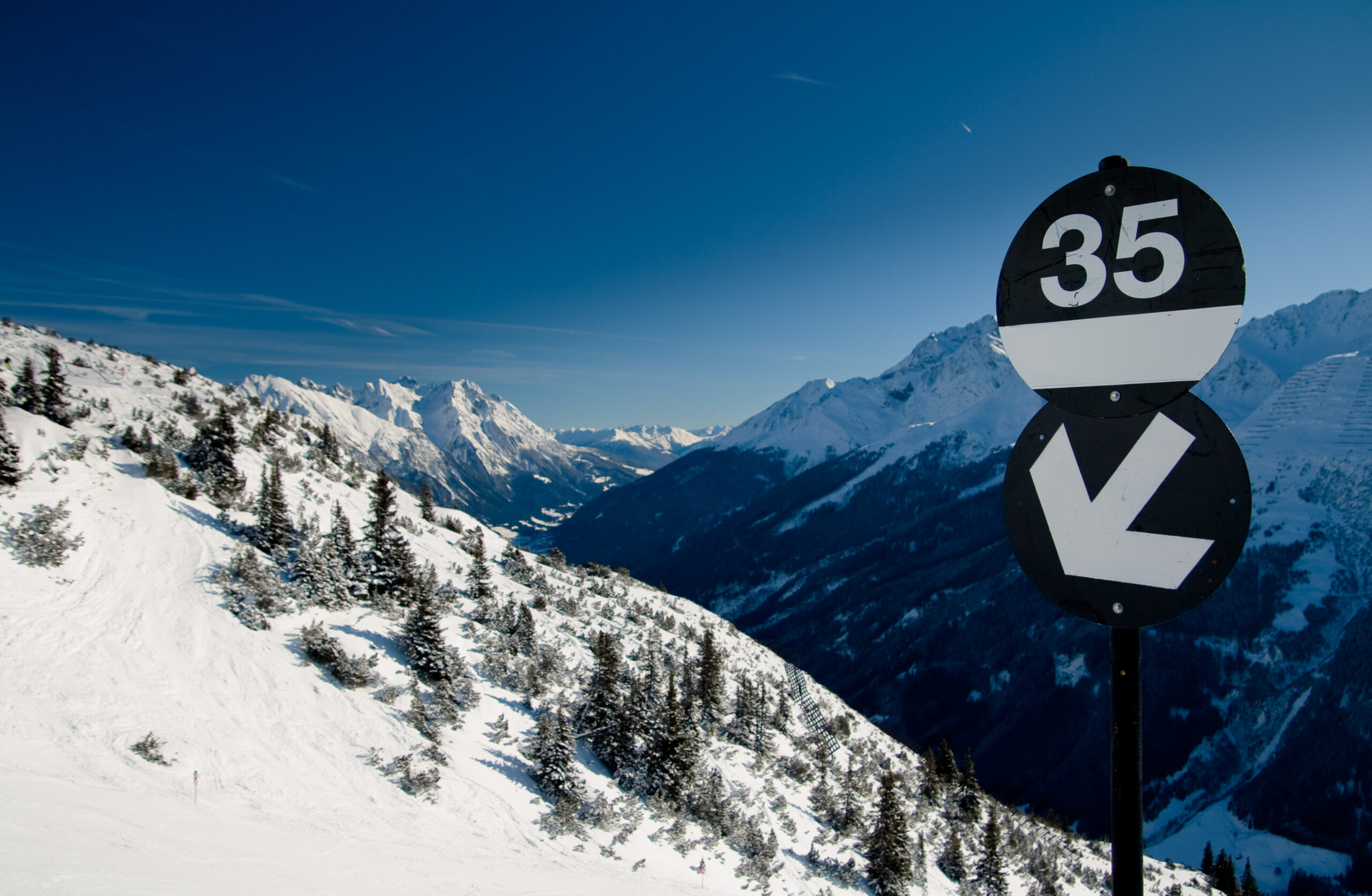
At the top end of the spectrum, we have the all-mighty black run. Not to be taken lightly, a black run pushes advanced skiers to their limits. With the piste exceeding gradients of 40% (The Swiss Wall in Avoriaz hits an eye-watering 78% gradient!) expect narrow chutes, knee-knocking moguls or very icy conditions.
On your piste map, you may also notice dashed black runs with a red or black square. These are typically off-piste areas that indicate a specified route for expert skiers to follow, and are reserved only for those looking for the ultimate challenge – with the correct safety gear.
- Potentially ungroomed, very steep and narrow
- Should only be undertaken by expert skiers looking for a challenge
- Best resorts for black runs include Avoriaz, Alpe d’Huez, Val d’Isere, Les Arcs and Courchevel

How Does North America Differ?
In North America, the grading isn’t too different; however, there are some key points to be aware of.
- Green circle = easiest slopes
- Blue square = moderately difficult slopes
- Black diamond = difficult slopes
- Double black diamond = very difficult slopes
In Europe, each colour indicates what a skier should expect; in North America, pistes are graded in relation to other runs in the respective ski area, so a blue square in one resort could have a completely different degree of difficulty from another. There is also no distinction made between marked slopes and open ski terrain.
Did you know? Walt Disney devised the grading system by asking people what colours they associated with difficulty.
Why is Ski Run Rating Important for Your Skiing?
Understanding the different ski run ratings is crucial for enjoying the mountains – the last thing you want to do is end up on a slope beyond your skill level too early. Not only is it not fun, but also dangerous for you as a skier and potentially for others around you too if you lose control.
It’s also a great way to track your progression – graduating from a green run to blue, and so on, is an exhilarating feeling and one that’ll keep you hooked! You’ll gradually unlock more of a ski resort, and be able to tick off runs you only once dreamt of achieving.
How to Read a Piste Map
Now you’re aware of the ski runs suitable for your skill level, a piste map immediately becomes less intimidating! Each piste, as well as being assigned a colour, will also have a name or number – for example, ‘9’ or ‘Kandahar’ to help you find your way when on the slopes.
The thick black lines on a piste map indicate the lifts and how to access different ski areas. They’ll also have a symbol to tell you what kind of lift it is, i.e. a gondola, chairlift, or drag lift. There’s other important information on your piste map too, including designated picnic areas, first aid, fun parks, slow zones, restaurants and toilets. It really is your guide to the mountain!
Remember to pick up a physical piste map! While most resorts now have a handy app, it’s also wise to carry a backup in case your battery drains in the cold. There are also plenty of enlarged maps at key points across the mountain, and at the bottom of a lift, it will usually signpost which pistes you can access at the top too.
Is it your first time? Check out our beginner-friendly ski holidays or our special Learn to Ski Week to meet like-minded newbies.

A winter lover, Annie first hit the slopes in her early teens before going on to complete her ski instructor qualification and two seasons in St Anton. While she’s now most often spotted on a snowboard, Annie still thrives on the thrill of chasing fresh powder and capping off her day with a little boogie – preferably at the Krazy Kanguruh!
Other articles you may like:
How to Ski: Tips for Beginner Skiers
Top 5 Best Ski Resorts for Beginners